
Sources for Suffolk County Previous Residents
The backward trail has two layers. The title layer identifies ownership and transfer dates. The household layer provides evidence of who may have occupied the address at a point in time. Suffolk County's strongest title source is the Registry of Deeds, while Boston's directory, tax, census, permit, map, obituary, and probate collections can supply context around a particular property. Each source has a different cutoff and access route.
| Address-history source | Coverage | Access channel | Evidence offered |
|---|---|---|---|
| Suffolk deed name index and images | Verified names 1973-present; 1970-72 re-indexing; images to 1800 | Registry portal and counter | Transfers, parties, dates, legal description, plans |
| Boston City Directory | 1789-1981 with gaps; annual from 1820; address section from 1930 | BPL and established digital repositories | Names, addresses, occupation, moves or absences |
| Boston tax books | 1822-1918 scanned; hardcopy or microfilm described to 1974 | FamilySearch and Boston Archives | Taxpayer, parcel, and address history |
| Federal census | Decennial schedules through 1950 currently public | NARA, FamilySearch, BPL databases | Household composition on the census date |
| Historical permits | Data after December 15, 2009; older images and plans by search or office | Boston Inspectional Services | Construction, changes, and inspection chronology |
Begin with the current parcel and its latest acquisition deed. Then move back through the Registry while the name index is reliable. For a historic household question, use the directory and census records beside the deed chain rather than expecting a deed to name every person who lived there. Tax books and maps are especially useful when the street address itself has changed.
Freeze a Suffolk County Address
Before searching backward, preserve the current number, street suffix, unit, municipality, ZIP, and parcel identifier. For Boston, Boston Property Lookup accepts a street address or its unique 10-digit parcel ID, not an owner name. The card can show the current owner, mailing address, property type, assessed value, parcel ID, tax and exemption material, permits, and a map connection.
Keep the situs address separate from the owner mailing address. Situs means the physical property location; the mailing address is the tax-bill destination. A different mailing address is a useful lead for a titleholder, not proof that the owner lived there. If the property is in Chelsea, Revere, or Winthrop, move to that municipality's assessor because Suffolk County does not have one countywide assessor roll.
Trace Suffolk County Previous Residents
The deed chain is the ownership backbone for address-history research. Search Suffolk Recorded Land by property or party, open the latest acquisition deed, and use its legal description and prior-instrument reference to avoid a same-address mistake. Old deeds may not carry a street address, especially as the search moves back, so the lot, plan, book, and page can become the more stable identifiers.
- Save the current assessor card, parcel ID, owner, mailing destination, and legal description.
- Run a Recorded Land Property Search by the complete street number and street name, then locate the current acquisition deed.
- Record the book and page or document number, recording date, grantor, grantee, legal description, plan, and any prior reference.
- Search that grantor as a grantee in an earlier period and match the legal description and lot or plan.
- Repeat backward, using a trust or entity name and trustees when the transfer does not name one individual.
- Grantor / grantee
- The grantor transfers an interest; the grantee receives it.
- Chain of title
- The connected sequence of recorded transfers for the same property.
- Legal description
- The lot, plan, parcel, or boundary wording that identifies land even when a street number changes.
For a 47-49 address, the Registry advises testing 47-49, then 47 and 49 separately. If an abbreviation is uncertain, try the first street-name component without its suffix. The search, image viewing, printing, and downloading are currently free, but the online data does not contain every Registry record.
Suffolk County Deed Records Boundary
The Registry's name index has a firm historical boundary. Recorded Land names and images are verified from 1973 forward, beginning at Book 8595. Results from 1970 through 1972 are being verified and re-indexed, so treat them as unverified. Older book images can reach Book 194 from 1800 through Unindexed Property Search, but that image access does not mean the older grantor and grantee names are fully indexed online.
When the online name trail ends, search by book or book and page, use Unindexed Property Search, and inspect the legal description and plans. The Registry also identifies 1951-1960 grantor/grantee indexes where relevant. Historical and genealogical work is best continued with Registry staff or research terminals at 24 New Chardon Street, Boston. The research counter is open Monday through Friday, 8:30 a.m. to 4:30 p.m.
Note: A deed image from an early book is evidence of a located document, not proof of a complete searchable name index for that era.
Registered Land and recorded land do not always use the same search path. The Registry offers name, document, book, property, certificate, recorded-date, and unindexed modes across its Recorded Land, Registered Land or Land Court, and plan areas. If a historical certificate or plan is found but not linked, the Registry advises calling Registered Land staff so the document can be indexed or linked.
Suffolk County House History Records
Boston Public Library's house-history guide brings together directories, address sections, census schedules, newspapers, Sanborn atlases, tax records, and Boston Streets. The Elliott Room's Local and Family History Collection and adjoining Washington Room staff offer a library route when a deed has supplied a name or a legal description but has not answered who lived there.
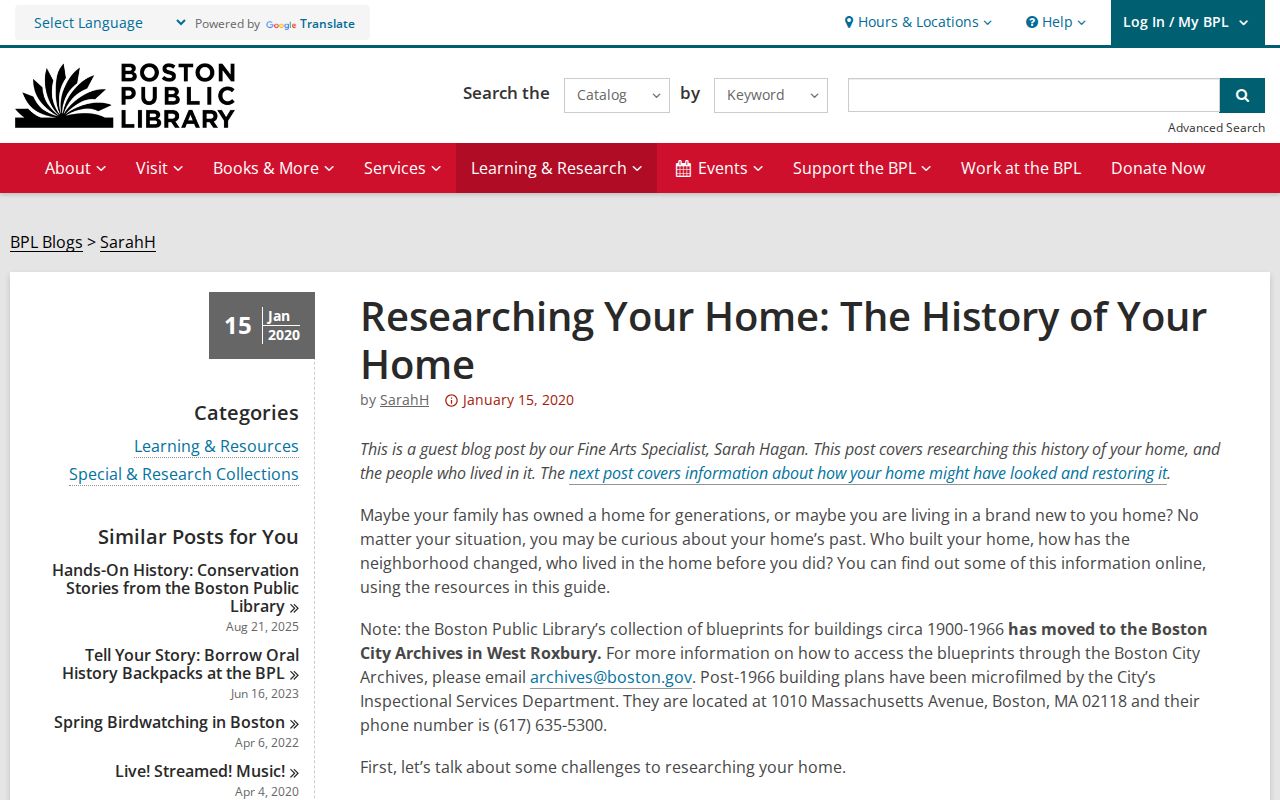
The house-history approach keeps title and occupancy distinct. A directory suggests an occupant. A census shows a household on its enumeration date. A deed shows title. Comparing them by year is more reliable than trying to infer every past resident from a single property record.
Suffolk County Address Directories
Boston City Directory editions span 1789 through 1981 with gaps, become annual in 1820, and add a separate address section in 1930. That address section supports a reverse search for a later address, but it does not make the volume a complete household list. The full holdings, digital runs, and entry conventions are available through the Suffolk County city directory collections.
The BPL directory guide documents the Boston run and the way entries should be read.
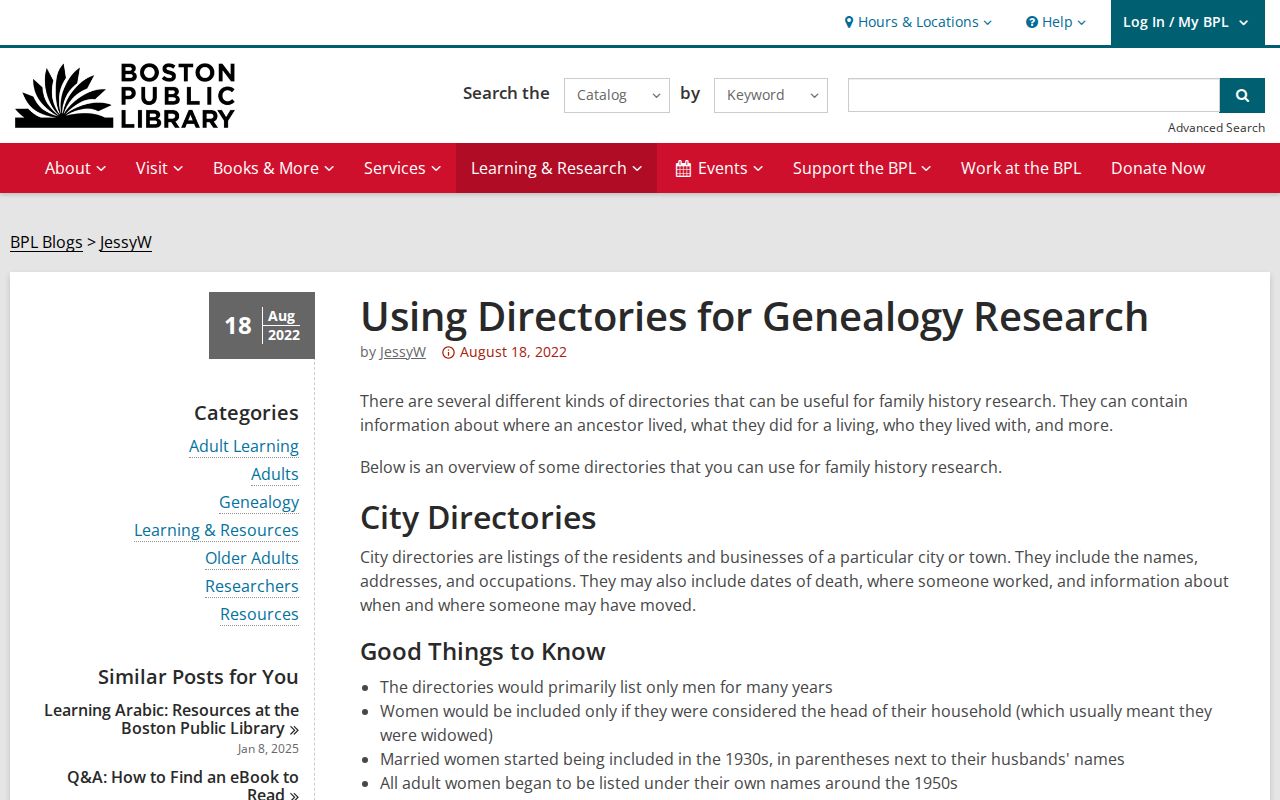
Pair a directory year with the closest released federal census. The 1900, 1910, 1920, 1930, 1940, and 1950 schedules can supply household composition, while a directory can narrow the interval between decennial snapshots. Record spelling, initials, occupation, spouse notation, address, and the volume's abbreviation key before deciding that two entries are the same person.
Suffolk County Tax Records and Atlases
Boston City Archives and FamilySearch created a useful address-history bridge by scanning Boston tax records from 1822 through 1918. The Archives describes tax records through 1974 in hardcopy or microfilm. A tax entry can supply a taxpayer and parcel context when a directory leaves out a woman, a child, a boarder, or another person who was not the household head.
Sanborn fire-insurance and real-estate atlases add the built form: footprint, construction material, use, parcel, and street context. Boston holdings can be checked through BPL, the Library of Congress, and Digital Commonwealth, but a full year-by-year list for every Suffolk municipality was not located. Historical permits are another dated layer. Boston permits after December 15, 2009 have a data search; older document images are separately searchable, while plans require an in-person visit to Inspectional Services at 1010 Massachusetts Avenue.
Use a map or tax record to test continuity, not to guess it. Filled land, subdivision, and a changed street grid can make the next street number a poor match for an older property. A stable lot, plan reference, parcel geometry, or deed description is better evidence when the address trail crosses a major change in the built environment.
Suffolk County Past Household Records
A property trail can end in an obituary, probate case, or a conveyance after a death. The BPL obituary index covers the Boston Evening Transcript, Boston Globe, and Boston Herald or Herald American; retrieve the source item after locating an index entry. Suffolk Probate and Family Court can provide estate and fiduciary context, while a new deed or tax entry can show the next titleholder. These sources confirm different facts, so compare names, dates, address, and legal description.
Boston City Archives keeps an ArchivesSpace catalog with finding aids and digital-repository links. It is an important source for municipal tax, voter, neighborhood, and administrative material that can explain a property record.
The Boston City Archives collections page provides the catalog route and the current access notice.
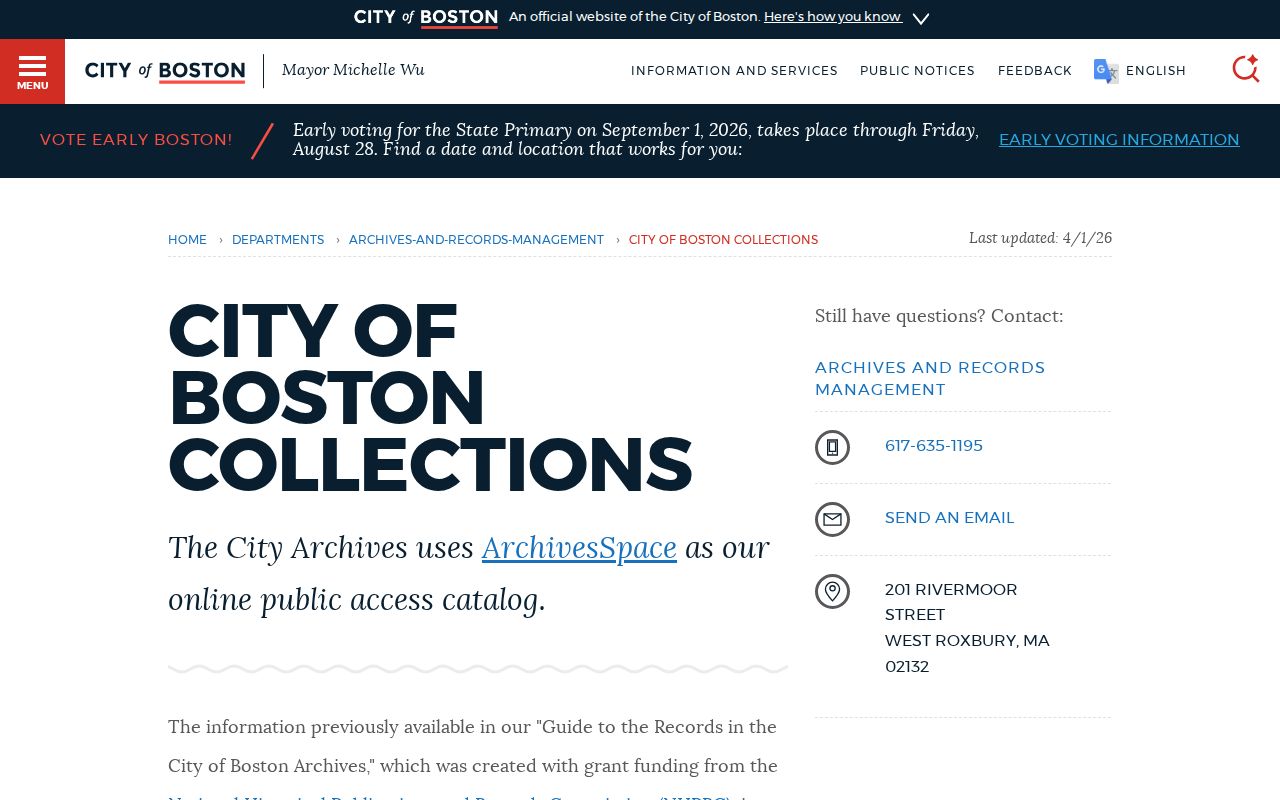
Public collection access is affected by shelving-improvement work through spring 2027. Use the digital repository and catalog first, then verify appointment and onsite status before traveling to the Archives at 201 Rivermoor Street.
Massachusetts public records requests are another fallback when a named custodian has a non-indexed record. The Massachusetts Public Records Law, M.G.L. c. 66, § 10, permits written requests to the custodian, subject to exemptions. State the address, date range, and record type precisely, and preserve the response with the property notes.
Lawful use. Suffolk County address-history research is suited to house history, family history, heir questions, and personal curiosity. Do not use an address trail to stalk, harass, or harm any living person.
Suffolk County Address Geography
A modern Boston address can hide an earlier municipality. South Boston separated from Dorchester in 1804; East Boston was annexed in 1836; Roxbury in 1868; Dorchester in 1870; Roslindale in 1873; Brighton, West Roxbury, and Charlestown in 1874; and Hyde Park in 1912. Search the former-town name in directories, deeds, maps, parish material, and cemetery records when the time period calls for it.
Street names and numbers can change with subdivision, filled land, annexation, or renaming. No verified countywide readdressing register was located. Use the deed's legal description, an old atlas, parcel geometry, and City Clerk or Archives records to bridge the address instead of assuming that a current number has always meant the same place.