
Suffolk County Directory Holdings
Boston supplies the main historical city-directory shelf for Suffolk County research. The Boston City Directory begins in 1789, has no editions for 1790 through 1795, appears irregularly from 1797 through 1819, and becomes annual in 1820. Its last printed editions are 1978 and 1981. The run has gaps, so use the title page of any volume as the citation for that year. Boston, Chelsea, Revere, and Winthrop keep separate municipal contexts, which matters when a search moves beyond Boston.
| Directory collection | Coverage | Keeper | How to use it |
|---|---|---|---|
| Boston City Directory | 1789-1981; annual from 1820 | BPL, State Library, Boston Athenaeum, established digital repositories | Open and library-based access varies by volume |
| Boston Streets samples | 1845, 1855, 1865, 1870, 1872, 1875, 1885, 1905, 1925 | Tufts Digital Collections | Free digitized directory cards and maps |
| Blue Book and Social Register | Blue Book 1876-1937; Social Register 1890-1976 with gaps | BPL Research Services | Onsite, selective coverage rather than a complete roll |
| Lists and telephone directories | Lists of Residents 1909-2014; Boston-area telephone runs | BPL | Many list volumes digitized; telephone material onsite |
Use the collection type to set expectations. A social register is selective. A telephone directory may omit people without a listed line. A city directory is not a census and can carry a person after a move or omit a boarder, child, or household member. The State Library describes its Boston directory run as 1789 through 1981, while BPL Research Services can help identify material for other Suffolk County municipalities and years.
Suffolk County Directory Changes
Boston directory structure changed in ways that affect a search. The earliest 1789 volume sorts only by first letter. A complete business section by category begins in 1847. The first separate address-organized section arrives in 1930, wives begin appearing beside husbands in 1933, and the last edition to publish death dates appears in 1961. A numerical telephone directory first appears in 1968.
- 1789: first Boston directory.
- 1820: annual publication begins.
- 1930: a separate address section supports reverse searching.
- 1933: wives begin appearing beside husbands.
- 1978 and 1981: final printed editions.
Before the address section, start with the alphabetical personal listing and browse the street where needed. After it appears, an address can lead to a household or business entry, but the result still needs comparison with the alphabetical section and another dated record.
Reading Suffolk County Directory Entries
A Boston directory entry normally starts with the surname and given name or initials. It may add an occupation, trade, employer, commercial address, or residence. Spouse notation is a dated clue, not a universal rule. Wives generally appear beside husbands only after the 1933 change, while earlier volumes often favor men or household heads and may identify a widow as the household head.
| Name | Surname first, then given name or initials; capture the spelling exactly. |
|---|---|
| Work or business line | May show occupation, trade, employer, or a commercial address. |
| Residence | Street number and street can identify a household lead. |
| Spouse or widow clue | Parenthetical spouse notation is more common after 1933; early representation is uneven. |
| Volume reference | Year, page, and scan-card metadata support comparison with adjacent editions. |
- Criss-cross directory
- A reverse directory arranged by street and number rather than by personal name.
- Householder index
- An index built around a household head, so it may not name every person at an address.
- Abbreviation key
- The volume's front-matter guide to its shortened terms and marks. Save it with the entry because keys can vary by year.
Do not carry an abbreviation from one city directory into another without checking that volume's key. A notation can reveal a useful direction for family history, yet the entry remains a dated publication record rather than a complete account of one household.
Suffolk County Directory Research at BPL
The Local and Family History Collection is in the Elliott Room on the second floor of the Boston Public Library Central Library, 700 Boylston Street. Staff work in the adjoining Washington Room. The collection has more than 30,000 materials spanning the 17th through 21st centuries, including directories, newspapers, maps, town histories, microform, published genealogies, and immigration material. Research Services can be reached at 617-536-5400 or ask@bpl.org.
The BPL directory research guide is a practical starting point for the shelf history and entry conventions.
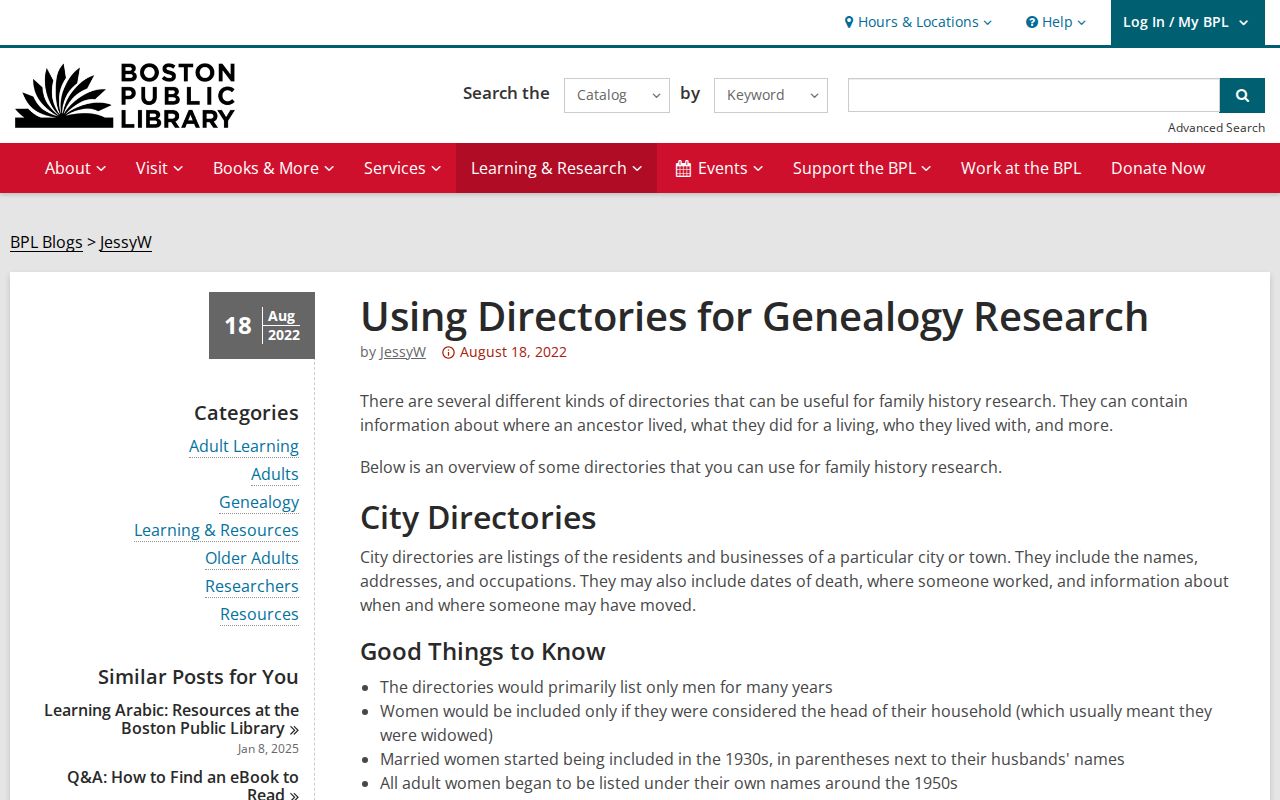
The guide helps distinguish a printed directory, an address section, a telephone run, and an auxiliary list before a researcher asks staff for a particular volume. BPL also says it lacks a substantial yearbook collection and does not keep individual-family files, so a yearbook or family file often requires another repository.
Library database access has its own limits. BPL lists Ancestry Library Edition, American Ancestors, FamilySearch, MyHeritage Library Edition, and its obituary database, with onsite or BPL-limited access identified on the individual database pages. Ask Research Services before a visit if a directory year, microform run, or database is essential to the search.
Suffolk County Digital Directory Volumes
Tufts Boston Streets provides nine digitized Boston directory samples: 1845, 1855, 1865, 1870, 1872, 1875, 1885, 1905, and 1925. The collection reports more than two million unique personal-section entries, along with maps and place material. It is a strong name-and-address route for its sampled years, not a continuous run.
For other years, the Boston Athenaeum project, established library databases, and the BPL collection can supply different formats and access modes. Search the exact name, surname variants, initials, and street abbreviations. Use occupation or spouse notation as a cross-check, not proof of identity. A modern record check can follow a historical match through the Suffolk County resident lookup.
Note: The Tufts collection has year gaps, so a missing digital result does not establish that the person was absent from Boston.
Digitization makes a page easier to reach, but it does not remove the need to inspect the volume year and scan metadata. BPL announced an AI-enhanced digitization initiative in March 2025 that may expand discovery of historic local collections. Check each collection record rather than assuming a particular directory, newspaper, or map has already been scanned.
Suffolk County Directory Companions
Directory research gains force when it is paired with material created for a different purpose. Boston Lists of Residents run from 1909 through 2014, with many volumes digitized. BPL's obituary index points to the Boston Evening Transcript, Boston Globe, and Boston Herald or Herald American, but it is an index rather than the full notice. Use the date and source title to retrieve the original through library resources.
The Massachusetts Historical Society collection guides are another established route for identifying Boston and New England manuscript collections and access indicators.
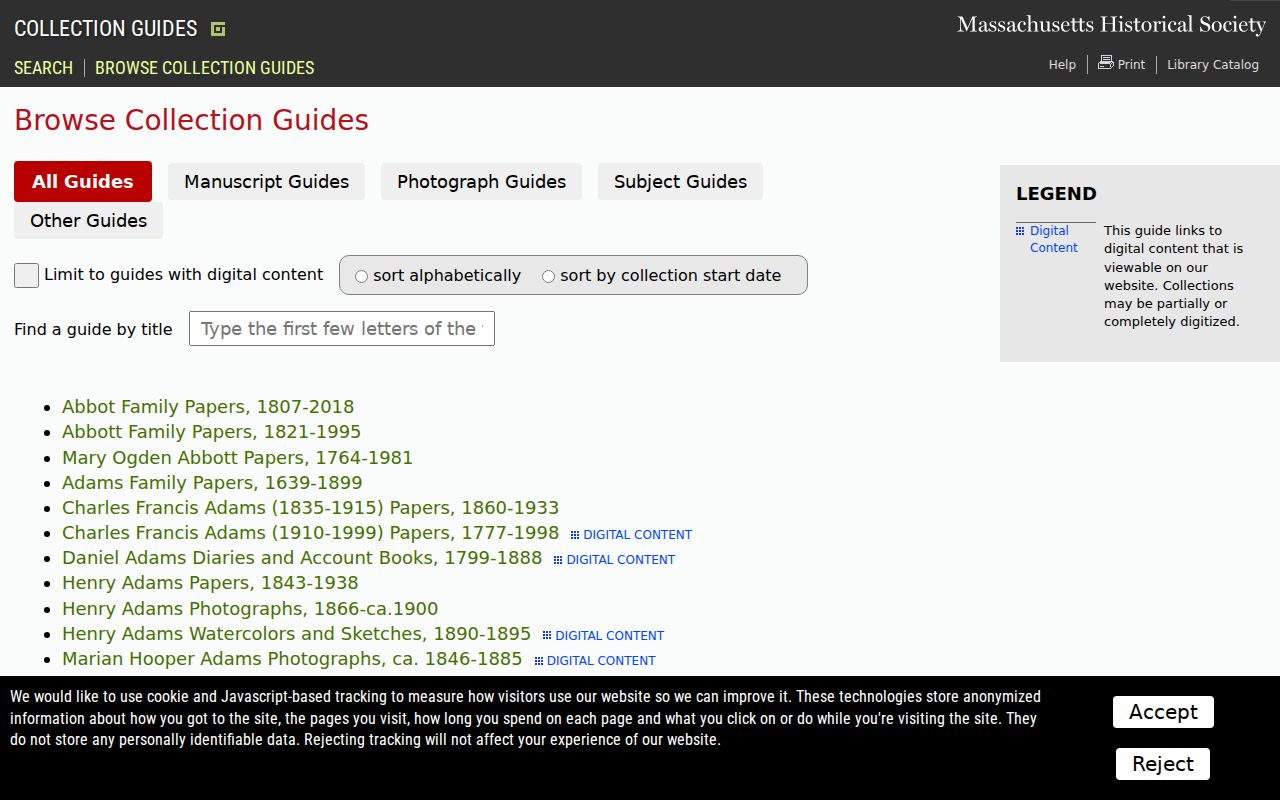
Those guides can help locate an organization, neighborhood, or family context that explains a directory address, but they do not turn a selective manuscript collection into a full list of residents.
For formal historical record questions, the Massachusetts State Library and Massachusetts Archives add directories, town histories, vital-record series, court and probate material, tax records, census resources, military material, and naturalization records. Their holdings are useful fallbacks when a Boston directory points to a former town, a court event, or a family move beyond the city proper.
Suffolk County Directory Limits
Early directories did not represent Suffolk County households evenly. BPL notes that people of color were listed separately from 1813 through 1848 or 1849. Women and children can be undercounted in early runs, and a person may be listed at a business, listed with initials, carried forward after a move, or absent altogether. These patterns make a negative directory result a limited finding, not proof that a person never lived in the area.
Compare the address and name with a released federal census schedule, a deed, a tax book, a permit, a cemetery record, probate, or an obituary. The latest public federal decennial schedule is 1950 under the 72-year rule. Each source answers a different question: a directory offers an address clue, a deed shows title, and a census captures a household at one point in time.
Trace Suffolk County Directories
Follow one household across adjacent editions rather than treating one entry as a final answer. Record the spelling, initials, address, occupation, employer, spouse wording, and the volume's abbreviation key. Then compare nearby years and the released census schedules. A disappearance may reflect a move, death, military service, a boarding-house change, or a publication gap.
- Find the name in an alphabetical listing for a known or approximate year.
- Copy the entry and the abbreviation key, then compare the preceding and following editions.
- For later volumes, check the address section to test the street and nearby household entries.
- Pair the directory span with the appropriate released census schedule and a tax, deed, or permit record.
- Use the BPL obituary index, cemetery evidence, or probate to test a death or inheritance event.
When a name changes form, search alternate spellings, anglicized versions, initials, and old street abbreviations. Boston's directories and archives cover many migration histories, so a surname alone is often too weak. A spouse, ward, parish, employer, or occupation can narrow a candidate, though none of those details should stand alone as identification.
Suffolk County Directory Geography
Older directory geography can look unlike a current Boston address. South Boston separated from Dorchester in 1804, East Boston was annexed in 1836, Roxbury in 1868, Dorchester in 1870, Roslindale in 1873, Brighton, West Roxbury, and Charlestown in 1874, and Hyde Park in 1912. Search the former town name alongside Boston when a record predates annexation.
Filled-land neighborhoods add another continuity issue. Back Bay was filled between 1857 and 1894, while other waterfront and industrial areas changed form across eras. An old atlas, legal description, or Boston City Archives tax record may clarify an address better than a modern ZIP label. Boston Archives access is affected by shelving work through spring 2027, so use its catalog and digital repository first and confirm access before an onsite visit.