
Find Suffolk County Resident Records
Suffolk County has no all-purpose county resident roll. Boston, Chelsea, Revere, and Winthrop keep separate municipal record systems, while the Suffolk Registry of Deeds and Massachusetts Trial Court provide countywide anchors. Start with an address when possible. Boston Property Lookup accepts an address or a 10-digit parcel ID, and its parcel card can supply an assessed owner, tax-mailing address, permits, and a map link. That record identifies tax and title context, not everybody who uses the address.
For one person, use two independent details before treating a match as meaningful, such as a full name plus a municipality, or a name plus a known address. The state voter tool is an individual status check, not a public list. A deed records a transaction, and a court docket records a case. Each source has a narrower purpose. When a current search fails, an older Boston directory, a municipal archive, or a written request to the right custodian can be the better next step.
- Write down the address, municipality, ZIP code, unit, and any former street or town name.
- Check the municipal assessor or GIS record for the parcel and keep the situs address separate from the tax-mailing address.
- Use the Suffolk Registry of Deeds search for recorded-party and title clues.
- For a past household, consult the Boston directory and obituary collections at the library before assuming a name disappeared.
- Ask the custodian for non-exempt offline material under the Massachusetts Public Records Law when an index ends.
Suffolk County Resident Records Offices
The right office depends on the question. The Registry preserves recorded land instruments for the county. Assessors maintain the current local tax record, but Boston, Chelsea, Revere, and Winthrop do not share one assessor system. Trial Court clerks and the Suffolk Probate and Family Court Register hold court records by department. The Massachusetts Secretary of the Commonwealth provides an individual voter-status check, while municipal election offices hold their own street-list and voter-list material subject to legal limits. Address-based research is covered in more depth in the Suffolk County street directory.
Suffolk Registry of Deeds
24 New Chardon Street
Boston, MA 02114
(617) 788-8575
Boston Assessing
Boston municipal property records
Boston, Massachusetts
Municipal contacts vary
Massachusetts Elections
Secretary of the Commonwealth
Statewide individual status check
Use the municipal election office for local lists
Suffolk County Address Records First
Boston’s property tool is useful precisely because its limit is clear: it searches by street address or 10-digit parcel ID, not by an owner name. A successful card can show the current assessed owner, the parcel’s situs, a mailing destination, assessed value, tax and exemption information, permits, and an open-map link. A tax-mailing address can be outside the property’s municipality, so it is a correspondence clue rather than proof that the owner lives at the parcel. Chelsea, Revere, and Winthrop require their own municipal property tools.
See the Boston Property Lookup screen before searching. It is the clearest start for a known Boston address.
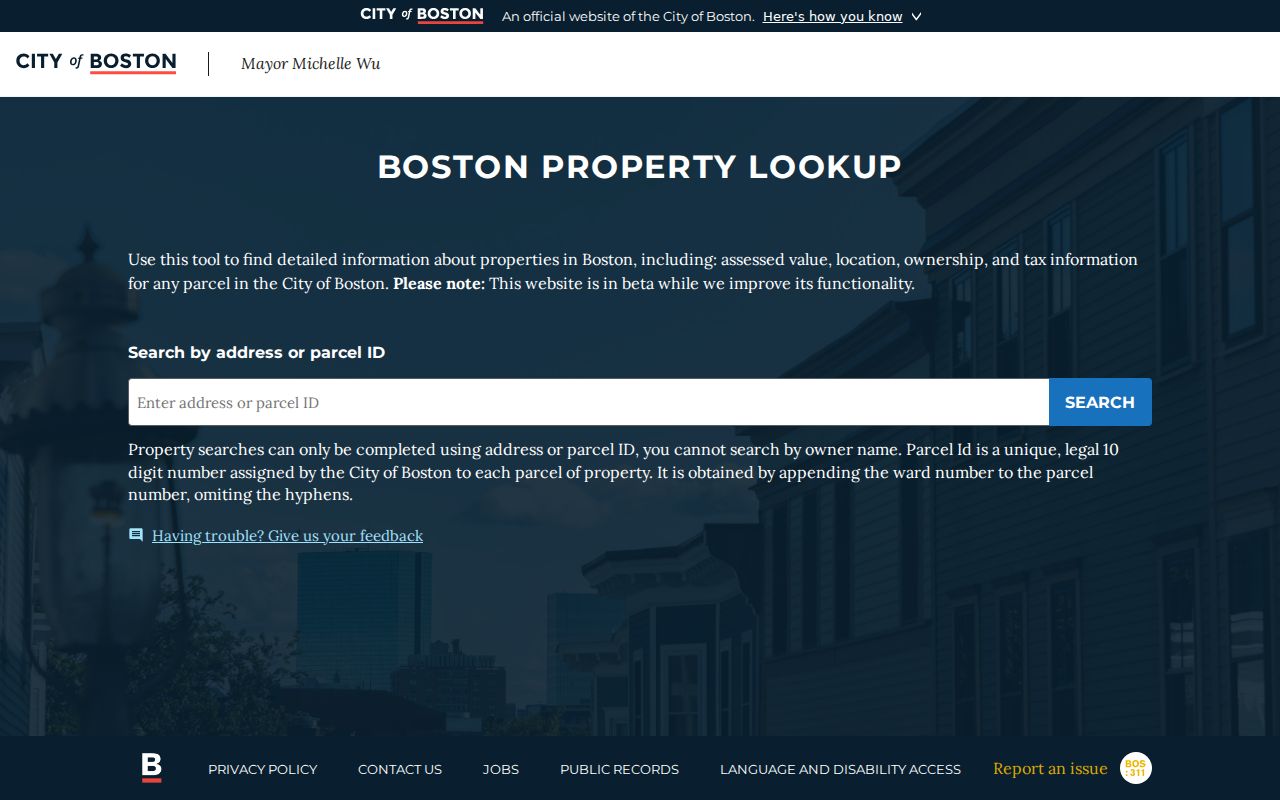
The address-or-parcel prompt explains why an owner-name search should move to the deed index instead of being forced through the assessor interface.
| Boston Property Lookup field | What it does |
|---|---|
| Enter address or parcel ID | Accepts a street address or a 10-digit Boston parcel ID. |
| Overview | Groups owner, mailing address, situs, parcel ID, and property type. |
| Property Value and Attributes | Shows assessment and classification fields. |
| Taxes, Exemptions, Abatements, Permits | Opens the associated public record categories when present. |
| Open in map | Connects the property detail to the municipal map. |
Suffolk County Deed Names
The Registry’s Recorded Land index is the countywide bridge between a property and a recorded party. Verified grantor and grantee names are indexed and imaged from 1973, beginning with Book 8595. Results from 1970 through 1972 are being checked and re-indexed. Book images reach back to Book 194 in 1800, but that does not create a complete historical name index. For older research, use Book Search or Unindexed Property Search, match legal descriptions and plan references, then use Registry staff and in-person research when necessary.
Search a party as the grantee on the acquisition instrument, then search that prior owner as a grantee in an earlier period. A grantor is the person transferring an interest; a grantee receives it. The recorded date, book and page, document number, plan, and legal description are the controls that keep a similar name from becoming a false match.
Suffolk County Voter Status Limits
The Secretary of the Commonwealth’s voter-status search is designed for an individual to check their own registration. It asks for first name, last name, month, day and year of birth, residential ZIP, and an agreement checkbox. Its result may report registration or pre-registration status, active or inactive status, polling location, and represented officials. It is not a street browse, a full voter file, or a way to locate every person in a ZIP code.
The official status form shows the required name, date-of-birth, ZIP, and agreement inputs.
Its restricted design helps distinguish an individual registration check from a municipal street-list request.
A municipal voter or street-list request is separate. Boston, Chelsea, Revere, and Winthrop have different custodians. A written request should identify the municipality, precinct or ward, date or version, and the non-exempt fields sought. Confidential registrants and protected identifiers are not disclosed. Note: A no-match can reflect a name variation, prior ZIP, recent registration, inactive status, or a protected record.
Current Suffolk County Resident Directories
Current records answer different questions. A municipal assessor card ties a tax owner to a parcel. A Registry record identifies parties to a land instrument. MassCourts identifies parties to a docket when the case is public. The voter tool supplies narrow self-status information. A state license or business filing can confirm an affiliation, but an agent or business address is not necessarily a personal address. These are directory-like sources, not interchangeable proof of present residence.
| Suffolk source | Record connection | Custodian | Access route |
|---|---|---|---|
| Municipal assessor card | Tax owner, situs, mailing destination, parcel and assessment | Boston, Chelsea, Revere, or Winthrop assessor | Municipal portal or counter |
| Recorded land index | Grantor, grantee, date, instrument and legal description | Suffolk Registry of Deeds | Free online search; counter for gaps |
| Voter self-check | One individual’s status, polling place and officials | Secretary of the Commonwealth | Name, birth date, ZIP, and agreement |
| Trial Court docket | Party, court, docket, case type and public status | Massachusetts Trial Court | eAccess or clerk for official copies |
| License and entity records | Licensee, officer, agent, status and filing context | DOL and Corporations Division | State search portals |
Use the narrowest official record that answers the question. A name found in a court docket still needs location and date checks. A parcel card should be compared with a deed before treating ownership as settled. The Suffolk County resident lookup workflow applies those cross-checks to one person rather than a street or archive run.
Suffolk County Court Name Checks
MassCourts and Trial Court eAccess help separate same-name people when a public docket exists. Select the court department and Suffolk location, then use party name, docket number, case type, attorney, citation, date range, or calendar fields where supported. A result can show party names, location, docket number, case category, entry dates, status, event dates, and sometimes public document links. It is case information, not a full identity record or a promise that every historic file is online.
The clerk or register who holds the file supplies official copies. Public terminals at courthouses and Registry sites can be useful when a web search is incomplete. Juvenile, adoption, sealed, impounded, and other protected material will not be fully visible.
The Massachusetts court-search entry page connects to the public docket system.
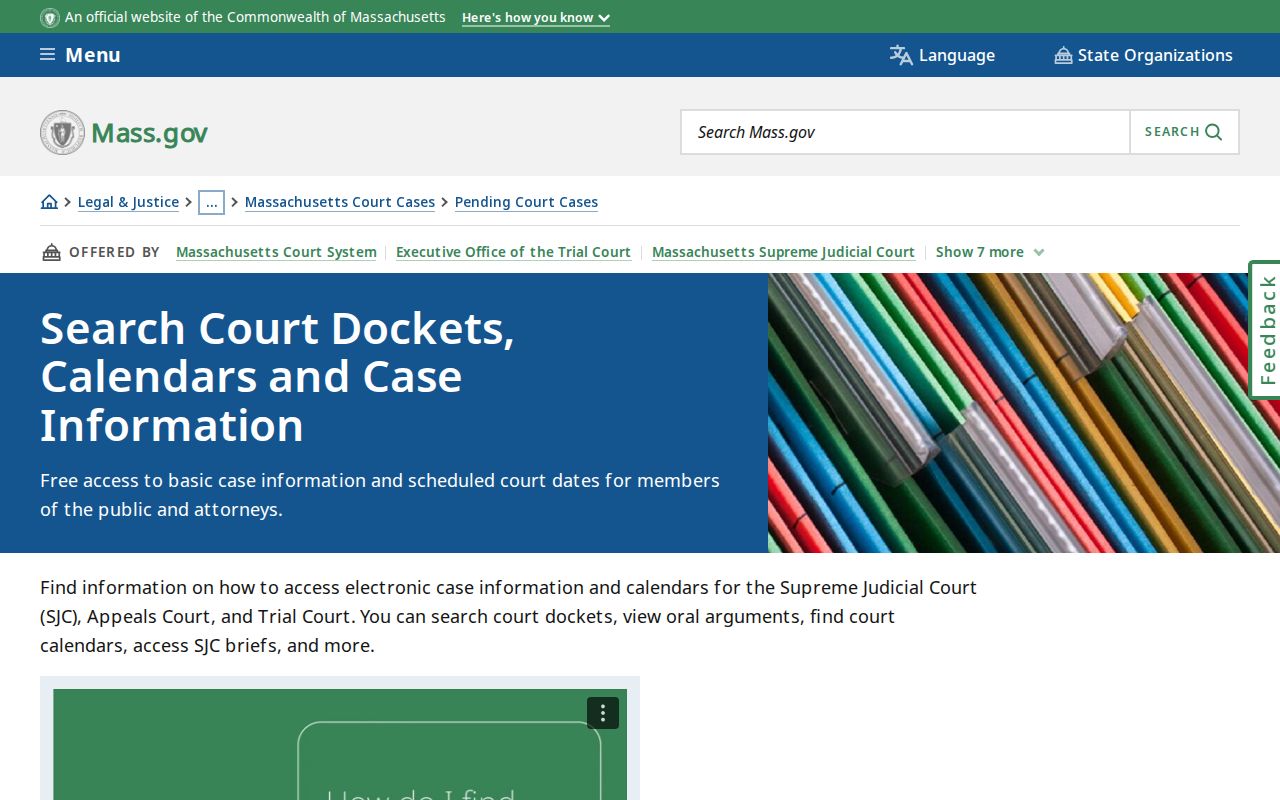
The screen is a starting point for a case search, while the filing court remains the source for public paper files and certified copies.
Suffolk County Vital Record Routes
Massachusetts vital records are not open to public online browsing. The Registry of Vital Records and Statistics issues birth, marriage, and death certificates from 1936 forward, while Boston or another local registrar may also keep a local event record. Earlier events can lead to the Massachusetts Archives or the municipality. An ordinary certificate request requires event details, identification, and eligibility documentation where the rules call for it. The RVRS research room provides appointment-based, on-site digital index images rather than a public name database.
The mail application accepts up to five searches per request. It asks for the subject or event details, applicant contact information, certification and signature, identification, payment, and a return envelope. Births to unwed parents, pre-adoption records, and death-record Social Security numbers have added limits. Since July 1, 2026, the full SSN on a death record requires a legitimate need under the amended vital-record law.
Suffolk County Records Requests
When an online search ends, the Massachusetts Public Records Law, M.G.L. c. 66, § 10, provides a route to the government custodian. Send a written request that names the record, date range, office, desired format, and whether inspection or copies are preferred. The general state guidance calls for an acknowledgment or response within 10 business days, though a complex request may bring an estimate, extension, or fee notice. A written copy also supports an appeal to the Supervisor of Records if a denial or fee is disputed.
That process does not override vital-record eligibility, court impoundment, adoption or juvenile confidentiality, the Address Confidentiality Program, confidential voter registration, or protected motor-vehicle data. Start with the office that made or received the record, such as the municipal clerk, Boston Archives, assessor, clerk of court, or Registry.
Boston City Archives has a public catalog, ArchivesSpace, with finding aids and digital-repository links attached where available. Its public-collection access is affected by a shelving-improvement project through spring 2027, so researchers should use the catalog and digital material first, then confirm appointment status before traveling to the Rivermoor Street location. For municipal files in Revere, the City Clerk is the public-records contact for City Hall, fire, DPW, water and sewer, and building, health, or site-plan records. A request should go to the city or court that actually holds the material, not to a general county office.
Some records simply have a different access route. Boston historical building permits can be searched by address, with post-December 15, 2009 permit data available through the online route and plans available in person at the Inspectional Services document room. Older court books and file papers may require a Massachusetts Court Archives request or an Archives inquiry. The RVRS research room offers appointment-based index access for vital-record research, while ordinary certificate orders use a separate application and eligibility process. Naming the correct access channel makes a request more precise and avoids promising a result that the law does not make public.
Historical Suffolk County Resident Directories
Boston’s first directory appeared in 1789. Publication became annual in 1820, and the last printed editions were issued in 1978 and 1981. The Boston Public Library keeps the major run, Boston Blue Books, Social Registers, telephone microfilm, Boston Lists of Residents, obituary tools, and a Local and Family History Collection in the Elliott Room at its Central Library. The State Library, Boston Athenaeum, Massachusetts Archives, and established digitized collections extend the historical shelf.
Directory pages can supply a name, address, occupation, employer, spouse notation, and volume year, but they omit people and may retain a stale entry after a move. A separate address-organized section begins in 1930, making later volumes particularly useful for tracing one address. The Suffolk County city directory collection explains the runs, entry conventions, and library routes in detail.
Suffolk County Former Town Records
A modern Boston address may sit in a place recorded under a former town name. South Boston separated from Dorchester in 1804, East Boston was annexed in 1836, Roxbury in 1868, Dorchester in 1870, Roslindale in 1873, Brighton, West Roxbury, and Charlestown in 1874, and Hyde Park in 1912. That history changes how an older directory, deed, map, parish record, or cemetery entry should be searched. Boston, Chelsea, Revere, and Winthrop are also separate municipal record environments inside the county.
Use a deed’s legal description, the parcel map, former-town name, and an older street name together. A ZIP code or current neighborhood label is a useful starting label, but it does not replace the historical jurisdiction that created the record.
Suffolk County Heir Record Trail
For an estate or family-history question, begin with a decedent’s name in Suffolk Probate and Family Court, then compare any public estate record with an obituary, a deed, and the state’s unclaimed-property search. Probate can identify a fiduciary, heirs, and property references. The BPL obituary index can point to the original newspaper date, while the Registry can show a later transfer. Each item should be checked against the same name, date, and address before it is treated as the same person.
Massachusetts makes unclaimed-property searching free. The official Treasury route uses name and address fields, then asks a claimant to select a result and start a claim. Identity and heir documentation may be required, and the state cautions people to avoid paid recovery solicitations.
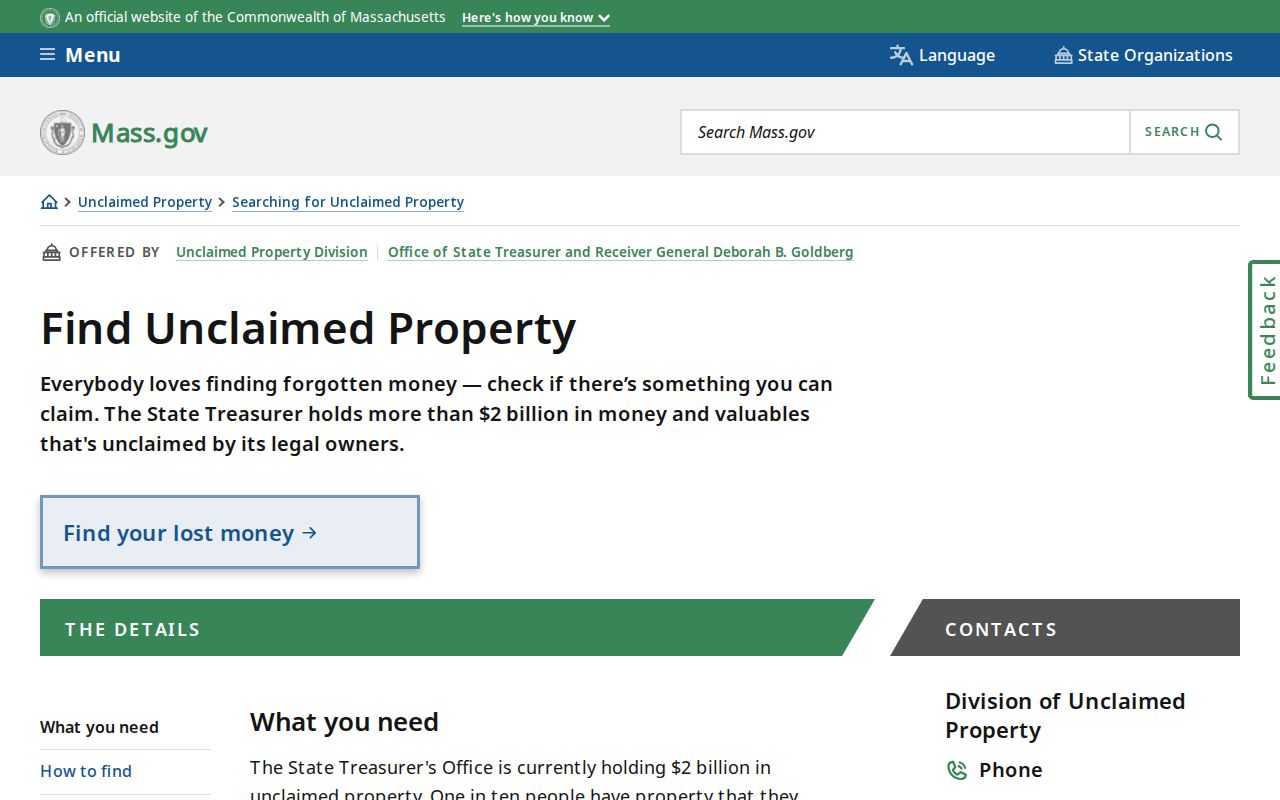
The official search is a family-record lead, not proof of an entitlement or a substitute for estate records.